
Two banks, one messaging problem
Core banking runs on IBM i. Almost nothing else in a modern bank does. Between the system that holds the accounts and the dozens of systems that need to know what just happened sits a messaging problem that gets harder every year: more channels, more consumers of the same event, and more regulation about what has to be recorded and when.
The traditional answers are point-to-point interfaces and nightly batches. Both work until the number of consumers grows, at which point the interfaces become the system and nobody can safely change any of them.
What we built
We brought Apache Kafka into the IBM i environment at Banco Santander and Andbank to streamline messaging between the core and everything around it. Publish an event once and let the systems that care subscribe. The core stops needing to know about its consumers, and adding a consumer stops being a change to the core.
Why it was recognised
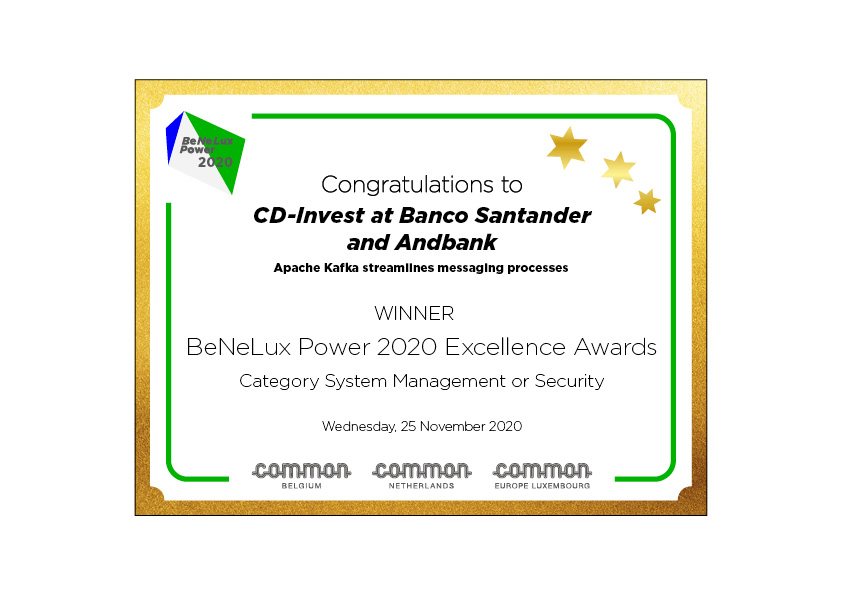
At the Power Benelux 2020 conference, COMMON — the IBM user community for Belgium, the Netherlands and Europe/Luxembourg — gave the work the Benelux Power 2020 Excellence Award in the System Management or Security category, on 25 November 2020. The citation reads “Apache Kafka streamlines messaging processes”.
At the same conference we were runner-up in Application Development. The award goes to the most innovative software project realised on IBM technology that year, and it is judged by people who run the platform rather than by a marketing panel. That is the whole reason it is worth citing.
Congratulations to CD-Invest at Banco Santander and Andbank — Apache Kafka streamlines messaging processes.
BeNeLux Power 2020 Excellence AwardsCOMMON Belgium · Netherlands · Europe LuxembourgWhat this one demonstrates
It answers the objection we hear most often: that an IBM i cannot take part in a modern, event-driven architecture. It can. It was doing so in production, at two banks, in 2020.
Source: the award certificate, and “CD-Invest wins two new Common Excellence awards”, cdinvest.eu, 24 December 2020. Note: the architectural description above is ours. Neither bank has reviewed this text, and banks are usually specific about reference rights — confirm before publishing.